" height="31.24706260921927px" id="nbJgwzqVl" transform="translate(0 0.753)" width="19.57646915609603px"/><path d="M 0 9.964 C 0 4.127 3.418 0 9.783 0 C 16.148 0 19.743 4.186 19.743 9.964 L 19.743 21.283 C 19.743 27.061 16.148 31.247 9.783 31.247 C 3.418 31.247 0 27.12 0 21.283 Z M 7.838 9.551 L 7.838 21.755 C 7.838 23.465 8.663 24.526 9.901 24.526 C 11.138 24.526 11.963 23.465 11.963 21.755 L 11.963 9.551 C 11.963 7.723 11.138 6.721 9.901 6.721 C 8.663 6.721 7.838 7.723 7.838 9.551 Z" fill="rgb(255, 255, 255)" height="31.247058794077702px" id="KjHS4S5x_" stroke-dasharray="" stroke-linecap="butt" stroke-linejoin="miter" stroke-miterlimit="10" stroke-width="0.38" stroke="rgb(255, 255, 255)" transform="translate(16.313 0.753)" width="19.74260705882354px"/><path d="M 0 9.964 C 0 4.127 3.418 0 9.783 0 C 16.148 0 19.743 4.186 19.743 9.964 L 19.743 21.283 C 19.743 27.061 16.148 31.247 9.783 31.247 C 3.418 31.247 0 27.12 0 21.283 Z M 7.838 9.551 L 7.838 21.755 C 7.838 23.465 8.663 24.526 9.901 24.526 C 11.138 24.526 11.963 23.465 11.963 21.755 L 11.963 9.551 C 11.963 7.723 11.138 6.721 9.901 6.721 C 8.663 6.721 7.838 7.723 7.838 9.551 Z" fill="rgb(7, 59, 58)" height="31.247058794077702px" id="MG5ESk6qo" transform="translate(17.762 0.753)" width="19.74260705882353px"/><path d="M 0 1.882 C 0 0.843 0.843 0 1.882 0 L 19.576 0 C 20.616 0 21.459 0.843 21.459 1.882 L 21.459 6.024 L 0 6.024 Z" fill="rgb(255, 255, 255)" height="6.023529411764706px" id="Wezeqb1qb" transform="translate(7.906 25.976)" width="21.458823529411763px"/></svg>)
Beyond Recyclable: How Luxury Brands Are Using Circular Packaging Design to Build Lifetime Loyalty
Recyclability has become the baseline, not the benchmark. Luxury brands are now designing packaging intended to be kept, refilled, and returned. Not binned. This circular approach reduces waste, satisfies tightening regulations, and, crucially, keeps customers coming back. If you're a founder or brand leader thinking about your next packaging brief, the shift from disposable to circular might be the most commercially savvy move you can make.
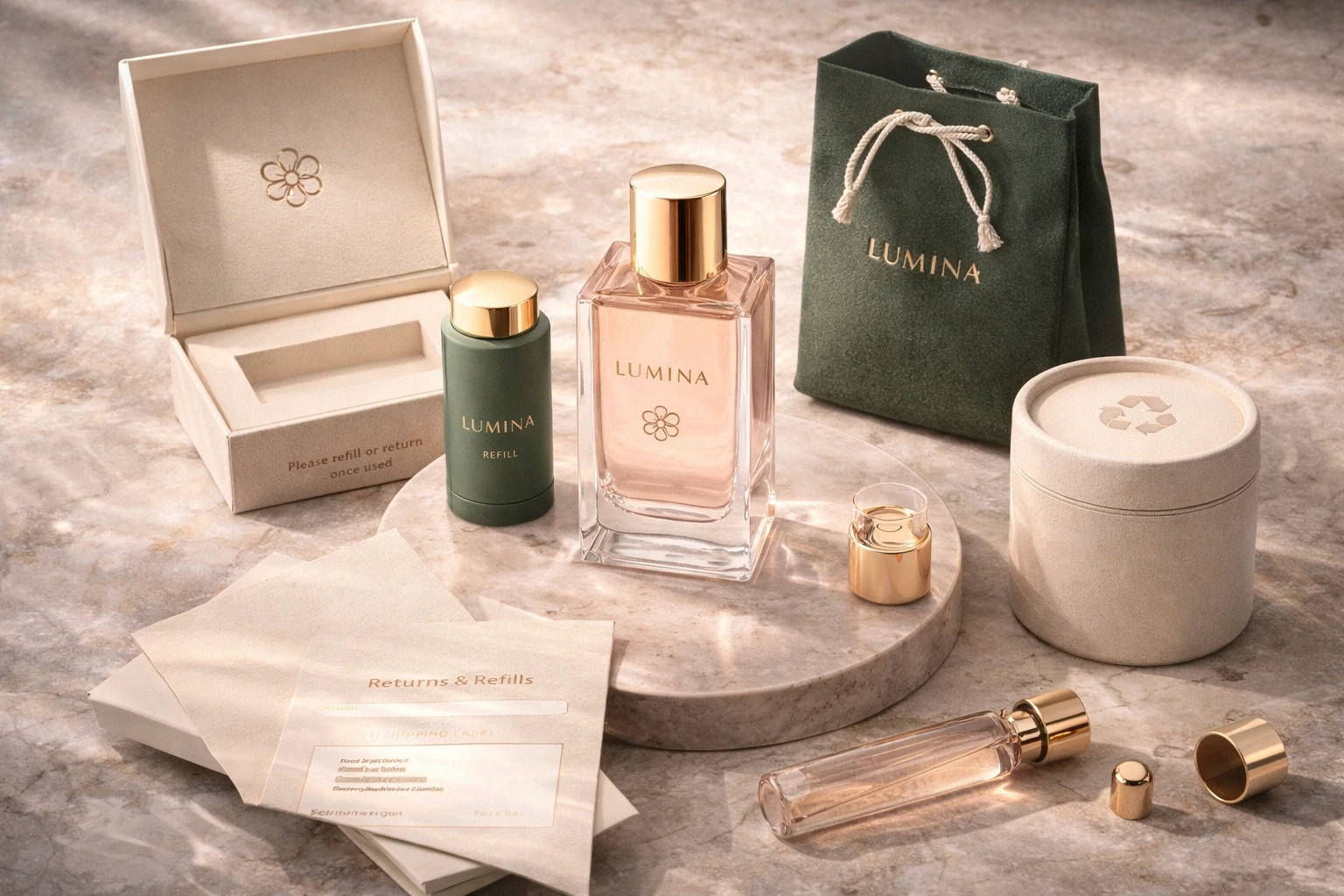
Why Recyclable Is No Longer a Differentiator?
Recyclable packaging used to feel like a statement. Now it's a minimum requirement, and in many markets, it's becoming a legal obligation.
EU Regulation 2025/40 (the Packaging and Packaging Waste Regulation, which entered into force in February 2025 and applies across all EU member states from August 2026, sets a target of 65% recycling rates for all packaging waste by end of 2025, rising to 70% by 2030. Brands that don't design for recyclability will face higher EPR (Extended Producer Responsibility) fees, with recyclability grades directly modulating what producers pay. In the UK, pEPR fees for large producers were invoiced from October 2025 based on packaging data already submitted, meaning the cost of non-compliant design is now a live financial reality, not a future concern.
So recyclability is fast becoming a compliance issue, not a brand story.
What stands out now is packaging that goes further. Packaging that customers don't throw away. Because they don't want to.
What Circular Packaging Design Actually Means
Circular packaging design goes beyond using recycled materials or printing a recycling symbol. It means designing packaging with its second, third, and fourth life in mind, before the first product is even filled.
In practice, this looks like four distinct models:
Refillable systems. The primary container is built to last, with a mechanism to replenish the product: at home, in-store, or via a delivery format. The packaging itself becomes an asset the customer owns.
Collectible or repurposed packaging. The container is designed with an afterlife beyond its product use: a perfume bottle that doubles as a bud vase, a candle tin that becomes a desk organiser, a gift box that stores jewellery.
Take-back and deposit schemes. Brands create mechanisms (whether in-store stations or posted returns) for customers to return empty packaging for cleaning, refilling, or material recovery. This keeps packaging in a closed loop and builds a repeat relationship.
Mono-material and design-for-recycling. At minimum, packaging is built from a single material type that can be cleanly processed, rather than laminated composites that contaminate recycling streams. This is increasingly required under the EU's PPWR "designed for recycling" targets coming into force by 2030.
The shift is from packaging as a one-way journey (product to consumer to bin) to packaging as part of an ongoing relationship.
How Luxury Brands Are Using Circularity to Lock In Loyalty
The commercial logic is straightforward. Customers emotionally connected to a brand have a 306% higher lifetime value, and repeat customers spend 67% more than first-time buyers. Circular packaging design is emerging as one of the clearest physical expressions of that emotional connection, because it gives customers something worth keeping.
Here's how the leading names are making it work.
Chanel, Dior, and La Mer: Refillable systems as loyalty locks
The leading prestige beauty houses have moved decisively into refillable formats. Dior, Chanel, and La Mer now use magnetic and screw-in refill systems that allow customers to replenish product without replacing the outer vessel. Chanel's approach uses lightweight aluminium cartridges, visible through transparent glass, making the refill itself a design feature rather than an afterthought. The refill insert for the Joli Rouge lipstick, developed by Aptar Beauty, uses a personalised lock-and-key mechanism that physically prevents any other brand's refill from fitting the case. The result is a packaging system that builds loyalty by design: the customer keeps the case, returns for the refill, and is physically nudged back towards the brand each time.
Mugler: The fountain model
Mugler has run one of the most commercially successful refill programmes in luxury fragrance. Its iconic Angel, Alien, and Alien Goddess bottles are available as refillable formats, with in-store Mugler Fountain stations allowing customers to replenish directly. This creates a reason to visit, and an event around what would otherwise be a functional repurchase. The fragrance market is seeing rapid growth in refillable beauty packaging, valued at over $45 billion globally in 2024, according to Future Market Insights, and Mugler's model is frequently cited as the benchmark.
Veuve Clicquot × Stella McCartney: Materials as storytelling
The 2024 Paris Fashion Week collaboration between Veuve Clicquot and Stella McCartney debuted a champagne bottle holder, handbags, and sandals in Italian VEGEA grape leather, a circular, regenerative material that looks and feels identical to conventional leather. Recognised at the 2025 Pentawards, the project demonstrated how next-generation circular materials can function as premium storytelling platforms in their own right, not just ethical footnotes. When your packaging material is a conversation piece, your brand gets carried into rooms it was never directly invited into.
Wild and the refillable aluminium model
Outside of traditional luxury, newer brands are building entire identities around circularity. Wild combines a sleek reusable aluminium case with 100% plastic-free, compostable refills, refills that break down faster than a banana peel. This turns packaging into a subscription mechanism: the case is owned, the refill is recurring. It removes the choice from every repeat purchase decision and builds routine at the brand level.
Dior: The collectible candle
Dior's recent candle launch comes in lacquered black glass jars with removable bases that can be interchanged with ones featuring iconic Dior prints: Toile de Jouy, monogram, houndstooth. The jar is not disposable. It's a canvas. Customers who buy once are incentivised to buy again: not for a new candle, but for a new base. This is packaging designed to sustain a relationship long after the product is finished.
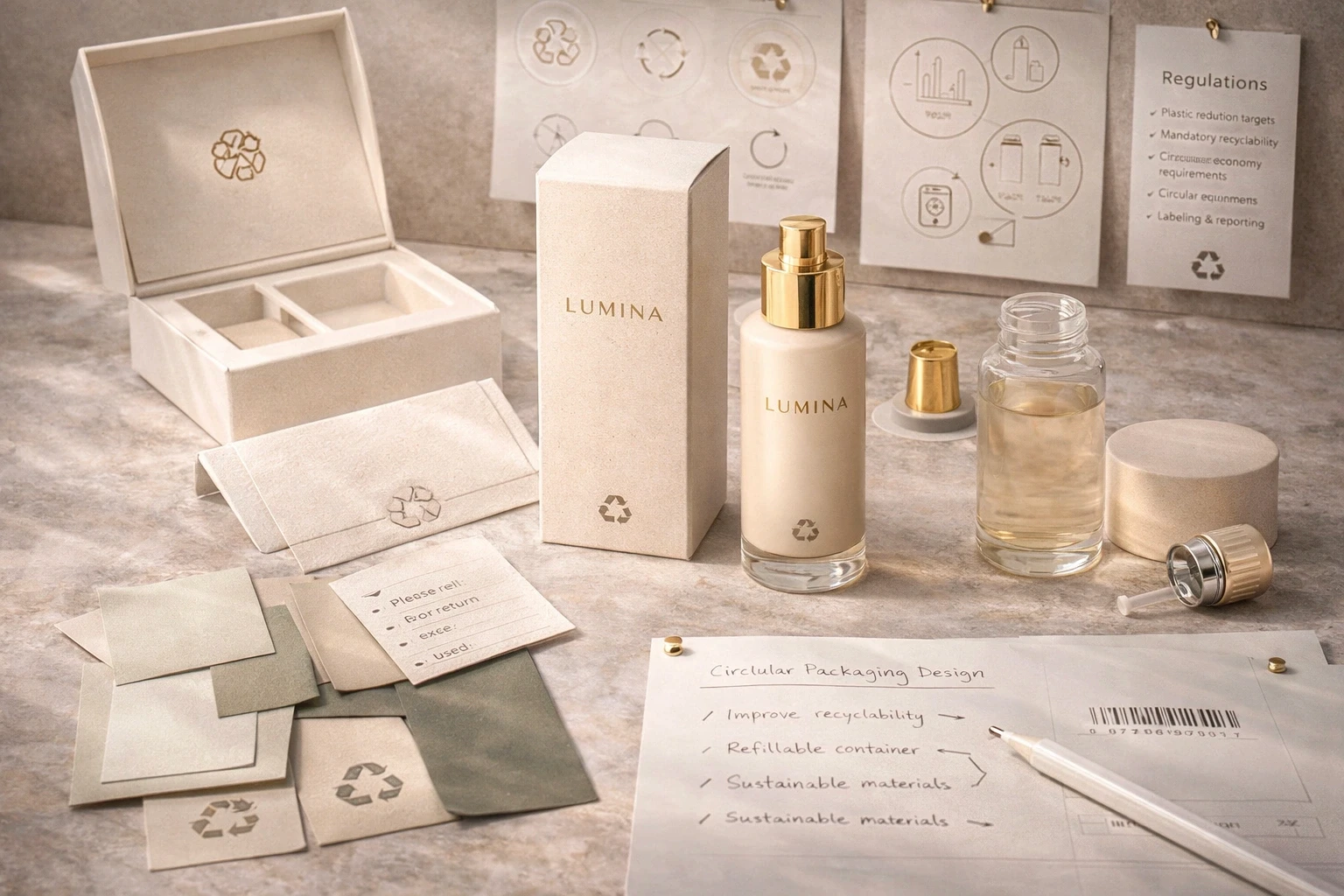
The Regulatory Pressure Making This Non-Negotiable
This is not a trend that will reverse. The regulatory direction in both the EU and UK is clear, accelerating, and carrying financial consequences.
The EU's PPWR requires reuse systems for reusable packaging to be in place from August 2026, with mandatory reuse rates for certain packaging types from 2030. EPR fees are modulated based on recyclability, meaning brands with poorly designed packaging pay more. The regulation also requires that all packaging on the EU market be recyclable in an economically viable way by 2030, with a ban on the lowest recyclability grade (grade C) packaging by 2038.
In the UK, pEPR fees have been active since October 2025 for large producers, with recyclability assessments (red, amber, or green) now determining financial contribution levels. Brands that have not invested in recyclable-by-design packaging are already paying for it.
For brand leaders, this means the question is no longer whether to invest in circular packaging design. It's whether to do it reactively, driven by compliance deadlines and rising fees, or proactively, as a brand-building move that earns loyalty before it becomes a legal requirement.
The brands that move first tend to own the story. The brands that follow tend to explain themselves.
What This Means for Your Brand's Packaging Strategy
You don't need a Chanel budget to apply circular thinking to your packaging. But you do need to brief for it intentionally.
Here are four questions worth bringing into your next packaging conversation:
What is the second life of this packaging?
If the answer is the recycling bin, you're designing to a minimum standard. Could it be a keepsake? A refillable vessel? Something a customer would feel guilty throwing away?
Where is the return moment?
Whether it's an in-store refill station, a postal return programme, or a collectible series that rewards repeat purchases, building a return mechanism into packaging design creates the physical infrastructure for loyalty.
Is your packaging designed for one material?
Multi-layer laminates and mixed-material formats are increasingly penalised under EPR frameworks. Mono-material structures not only reduce compliance costs and are also easier to design beautifully.
Does your packaging tell a story worth keeping?
61% of consumers are more likely to repurchase a luxury product when it comes in premium packaging. Packaging that carries meaning (provenance, craft, sustainability) is packaging that earns its shelf space long after the product is gone.
Circular design is not a constraint. It's a design brief with a longer horizon than usual. And for brands serious about building lifetime loyalty, it may be the most important brief you write this year.
Frequently asked questions
What is circular packaging design?
Circular packaging design means creating packaging with its next use in mind: whether that's a refillable system, a take-back scheme, a collectible format, or a mono-material structure that can be cleanly recycled. Unlike conventional packaging designed for single use, circular packaging is intended to stay in use rather than enter the waste stream. It reduces environmental impact, supports regulatory compliance and, when done well, builds stronger emotional connections with customers.
How does circular packaging build customer loyalty?
Circular packaging creates recurring physical touchpoints between a brand and its customers. A customer who owns a refillable vessel must return to the brand to refill it. A customer who collects seasonal packaging variations has an ongoing reason to engage. These interactions accumulate into emotional connection. Research shows that customers who are emotionally connected to a brand have a 306% higher lifetime value than those who are not (Motista).
Which luxury brands are leading on circular packaging?
The most visible leaders include Chanel, Dior, La Mer, Hermès, and Mugler in beauty and fragrance, and newer entrants like Wild and Humanrace in personal care. In spirits, Johnnie Walker and Veuve Clicquot have made significant moves. Each has taken a different approach: refillable inserts, proprietary lock systems, in-store refill stations, collectible secondary uses. All share the principle of designing packaging to outlast a single use.
Is circular packaging only viable for luxury brands?
No. While luxury brands have led the shift, partly because their customers already expect premium, lasting design, and the principles apply across price points. Brands at any level can design reusable outer packaging, create refill formats, or build take-back mechanisms. The key is matching the execution to the brand's aesthetic and the customer's behaviour. Wild, for example, is not positioned as ultra-luxury, but its aluminium refill system is widely regarded as a best-in-class circular model.
What regulations are driving the shift to circular packaging?
In the EU, Regulation 2025/40 (PPWR) applies from August 2026 and requires brands to design packaging for recyclability, meet escalating recycling targets, and pay EPR fees modulated by how recyclable their packaging is. In the UK, pEPR fees have been active since October 2025 for large producers. Both frameworks financially penalise brands that have not invested in circular design, making proactive investment not just a brand decision, but a cost-management one.
Final Thoughts
Packaging has always been a brand's first physical handshake with a customer. What's changing is how long that handshake lasts.
The brands building the deepest loyalty in the luxury sector are designing packaging that never quite gets put down: a refillable bottle on the bathroom shelf, a collector's jar that earns a permanent spot on the desk, a seasonal box that gets kept in the wardrobe for years. The product gets used. The packaging stays.
That's not an accident. It's a brief.
At Sleeve Office, we've seen circular packaging design affect how brands perform at shelf in a very specific way: the brands that brief for a second life from the start consistently create more considered, more distinctive packaging than those that retrofit sustainability at the end of a project. It's why we believe the circular brief isn't a constraint — it's one of the clearest routes to packaging that genuinely earns its place in a customer's life, long after the product is gone.
If you're thinking about what circular design could mean for your brand, or you're working towards a new packaging launch, we'd love to hear about it.
Get in touch with the Sleeve Office team and let's talk about your packaging that works harder, for longer.